30 September 2014

First lecture!

Standing up in front of a room full of people and telling them about something scientific: I've been doing it for many, many years. When I was a student pretty much every module we did in years 4 and 5 involved us presenting our findings to our fellow students. And from my PhD time on, I've done plenty of presentations at conferences. That's a completely different audience; you tend to get THE experts in the field in front of your nose! I remember once presenting at EGU and seeing Laurent Labeyrie on the front row - he's quite a big cheese. It made me a bit nervous! And that got worse when the convener invited the room to ask questions, and immediately his arm shot up! Luckily I had an answer to his inquiry.

I've also done presentations for job interviews, and lunch talks, and I did a research seminar here in Bangor only weeks after I started the job. So a lecture, that would be the same, wouldn't it? But no... to me it is not. And when term was about to start I got a bit nervous. I mentioned before, in this post, why; mainly because I was module leader on a module, and that means you're responsible for the whole shebang. And I'm new here! How do I know how everything works.

So as I said, I was a bit nervous. The Friday before term started I made the website live. And then I rehearsed my first two talks a bit. And made sure I got to the venue early! I do pretty much all my teaching in Bangor itself; that's some 20 minutes on bike away. I had been in the building of the first lecture before, but never in the room. Let alone that I knew what time the building would open, if the room would be locked, if I would manage to work the projector...

All ready to rock!


Then the students came in. 37 new faces. It should have been 43, but hey, this is university. I thought it was a fine number! And at 9 sharp I started. And it went well! I had 30 slides. If I am not careful, I can do two per minute. I now clearly had to do two minutes per slide! So I tried to take it easy. When I was a student I also appreciated lecturers who spoke calmly. And I thought I managed quite well. And in addition to that, I got some reponse! I asked them why they thought there were hardly any ice shelves in the Arctic, if they had heard of Lake Agassiz en what it is famous for, what they guessed the albedo of sea water is approxiomately, and all that kind of things. And sometimes an answer came! I was quite enjoying it. And when i was done after 45 minutes (oops, not slow enough) I felt good, and looked forward to the next lecture the day after. A good start of my lecturing career!

29 September 2014

More underground cliffhangers

I have reached the stage where weekends and evenings belong to work! But I make an exception for Thursday. I allow myself one short working day, as I think I'd go a bit daft if I never relented. And the underground trip this week was just so very enticing! The last time I had been in this mine, we had ended up concluding our maypole wasn't high enough to reach another level up. The week I'd been in the Netherlands the others had extended the maypole, clambered up, and found a shaft going up even further. Exciting! They had plonked two sections of maypole in the shaft but had run out of time. It would be up to us this week to connect the two pieces, and clamber up, and see what was at the top of this shaft! At least, that was the plan.

First we had to get tese two pieces assembled. Phil clambered up the maypole, got off at a convenient ledge, and placed the connection piece on top. Then I joined him at the ledge, and together we tried to lift the shorter piece on top of the longer one. But we weren't tall enough!

Phil on his ledge, and me below on the maypole. Pic by David.

I went down again, and up went David, who is easily the tallest of the lot. But after a lot of faffing we decided it still wouldn't work this way, and that we should instead lift the long bit on top of the short bit. And that wasn't easy; as it was, the connection wouldn't fit over the top of the short piece, and we didn't have the proper tools to change that. Luckily we had Pingu with us; he is a roady, and can improvise anything with scaff. So he managed, even without proper tools. And then with combined forces we managed to lift the two sections on top of each other and bolt the two together. Time to get up and see if we could get off at the top!

David volunteered, and had a look. One sees coming what he reported back, I suspect: it still wasn't long enough! He could see that there was a level going off, but no way of getting there safely. And all the faffing had taken time. We decided to leave it for next week. The plan is to go to the top of the maypole, drill some holes in the rock, anchor the pole, extend it even further, climb up, get into the level, bolt that too, and then lower a rope. Ropes are a lot more user-friendly than maypoles...

When David had come down Pingu took the opportunity to clamber up and have a look. And when he'd come down I did the same. But I didn't even dare go to the very top! A maypole is a bit bendy, so it tends to sort of asymptotically press itself into the wall as you come higher. And standing on a very high vertical construction that's not fixed to anything is scary: it feels like it will topple backwards! And it probably won't, but I decided to not take chances. And that it leans so closely to the wall that there isn't much space for your toes, or for your hands fitting around, doesn't help either. And when standing still you can fix yourself to it, so if it topples over you won't fall to the ground, but that doesn't help during ascent or descent. And isn't entirely reassuring either. I'll be braver (well, less scared) once that thing is fixed to the wall. But it does mean I hope someone else will be willing to do the drilling. We have several blokes whom I suspect of doing just that without much batting of eyelids, but blimey, that shouldn't be taken for granted. Anyone keen on standing some 15 high on a rickety, un-anchored, vertical structure, fixed to it, but not even holding on to it as both hands are needed for the drill? And then pushing away from the wall, as otherwise the drill bit won't get in? Anyone?

26 September 2014

Overdue visit to the Netherlands


I’d been in the Netherlands for Christmas. And then I applied for the Bangor job. And got it. And had to work hard to finish as much as I could of my York work. And then I moved house. And then I went to Vienna, and not much later to South Wales and then I went offshore for 6 weeks. And then summer was over! I hadn’t seen a family member for such a long time. And even though it wasn’t going to get any calmer, I decided it was time to pop over to see everyone. My mother would have her birthday, and everyone with whom I’d had Christmas dinner in Harderwijk had collectively turned 300. A nice age! Which needs some celebration. So I booked tickets. 

I first spent some time with my mother. As I do! It was nice to see her. She had wine and cheese and time to catch up. And I took the opportunity of going for a few runs from her house. And Amersfoort, where she lives, has been so familiar; I went to school there. But that’s more than 20 years ago, and every time I go for a run I am reminded of just how different it all is.

This part hasn't changed at all - it was the prettiest part of my school commute

 This was clearly done up! Looks nice.

I also went to Amsterdam, to see some friends. A lot had happened since I saw them last. Both an old-fashioned Amsterdam pub (the landlady called me “mop”!) and Roelof’s house provided a venue for discussing all that. And I got to see Micha’s atelier. From the street not much indicates such an arty hotspot exists there! And it had even not burnt down. 

And on Sunday I saw more family; my father and Dutch sister plus family. Or in other words, the collective that had turned 300. With my stepmother doing the honours of reaching that round number when turning 70. And to celebrate that, we visited Pampus, the little fortress island just NE of Amsterdam, guarding the harbour. It never really did much defending; not only does it seem to have been built fearing flat-bottomed German boats that didn't turn out to exist; it also lost its strategic function when people were so rude as to invent the use of airplanes for war purposes. And we were lucky; the fort seems to be festooned with "the Pampus experience", but the computer had crashed and they didn't manage to start it. So we just had the fortress, without all the hoo-ha! Excellent.

The ferry to Pampus went past an impressive ghost ship

Pampus in sight!

Pampus' dry moat

I spent some of the time either lugging my 7-year-old niece around, or discussing things like the loss of one's native language upon leaving one's motherland with my eldest nephew. I am still afraid of children, but these are now so old I had a great time with them! 
And a drink afterwards! With the three who contributed most to the cumulative 300 years on this pic.
And then time was up. My draft lectures were waiting. I flew to Manchester, drove home, parked the car, ate a sandwich and went to the office. There is a reason I haven't been visiting much this year, and that reason hasn't gone away yet! I'll see everybody again around Christmas...

23 September 2014

Teaching is nigh

When I accepted my current job I pretty much knew that the first term of the new academic year would be devoured by teaching. I was glad I had some of the summer to prepare! But summers rush past like nothing on Earth and before I knew it, I was less than two weeks away from my first lecture. And that's fairly nerve racking.

It's not even the lecturing itself that I am worried about. It is a humongous job; in this first term (September-December) I have to give 10 lectures on glaciology, 3 on shelf seas, and one on sea level change. In addition I have to do one day in the field with the students, do a practical with them in which they process the data they gathered in Laugharne, and assist with the Palaeoceanography practicals and students' presentations. And that is a lot.

 That will be me!

I now have to teach more glaciology than I myself ever had. I have to do a lot of reading up on it! And the shelf sea lectures are a lot more specific than the work I have so far done on such environments. The sea level lecture isn't so bad, but even on a topic you're familiar with, you need preparation to talk about it for an hour, in a well-illustrated and well-documented way. And I was there when the Laugharne data was gathered, but that doesn't mean I knew the software the students would be using, what data format that software required, and more of such things. And the fieldwork; half of it takes place somewhere I haven't been, doing measurements I've never taken. I have a lot of prep to do on that too.

But what worries me more is all the admin that surrounds it. This is 2014; you can't just rock up, give some lectures, and have the students do an exam at the end of it. No! In advance you have to make all your lectures available to the students online, and you have to also tell them online how you will assess them, when all the deadlines are, how things will be marked, and how they will be receiving feedback. And I'm already a bit confused by this new environment (it's easier to start teaching at your Alma Mater - then you have some idea of how things work!), but all this online business is new to me. I'm old! When I was a student myself the lecturers used overhead projectors. You got your grades on a piece of paper on a noticeboard. How these were generated was something you were just told. And it's rather daunting if you suddenly have to make decisions on deadlines and assessments if you have no idea why things are the way they are. 

I don't think I'll see an actual blackboard during any of the lectures, but Blackboard (TM) is ubiquitous!

I have help, of course. The woman who taught all of this last year now lives in Canada, but she does reply to email. And it used to be James' teaching, and he's around, but he has so much on his plate I try not to bother him too much. And it matters I get things right; the students pay £9000 a year, and it's bad enough they have to learn their glaciology from a non-glaciologist (as well-meaning as I may be), but if I accidentally refrain from putting some crucial information online because I didn't know I was supposed to, I'm sure the complaints will be flying in left, right and centre. And I would like to avoid that! So the time has come to work weekends and evenings. I'm not sure for how long. Very long, I suppose, as by the time the worst of the teaching has passed I will have a backlog in my research! But that's life as an academic. It's not that I condone that this is the norm; it would be better for everyone if both teaching and research would not be performed under such time pressure. But hey ho. Let's just jump in and hope I swim instead of sink. Wish me luck!

18 September 2014

More radiocarbon

I know I should concentrate on my upcoming lectures, but I get very distracted by dating. A cruise can have such effect! I mentioned already I had brought some samples back from the boat; both shell fragments and the likes, taken from the sediment cores on board, and a few bulk samples to sieve out, to see if they'd yield something. All for radiocarbon dating. This project only deals with times going back some 26.000 years, so well within radiocarbon reach! And by now the sieving is done. I've weighed what I have sieved out. It is time to make a decision on how to apply when for having which ones dated. It's important! Without age control our whole project falls apart. So this is crucial! But so is teaching preparation. I'll just have to juggle the two. Welcome to academia!

 I found two of those in my samples, and if it's up to me I'll date them both. From http://www.anemoon.org/Flora-en-Fauna/Soorteninformatie/Soorten/ID/585/Zeeboontje

17 September 2014

Fell running; quite something!

I spent half my youth with bandaged ankles. I spent half my adult life in knee braces. I rely heavily on orthopedic insoles. I'm not worth much from the knees down! And it runs in the family; both my sisters have, or have had, issues with at least one of the mentioned body parts. I remember once going to a physiotherapist for my knees. I figured she'd want to prod my knees a bit, and thought I'd prepare, so I'd taken my tights off, which only works if you remove shoes as well. She walked in and said "ah, I see, you come for your ankles, yes they do look rather bad". A later physiotherapist I saw about my knees said I only have propulsion muscles, and no balance muscles, so as long as I'm on a bicycle and only perform motions prescribed by the paddles I'm alright, but woe be me if I try to actually walk. Especially on rough terrain. Especially fast! You can tell, the last sport I should take up is fell running. If I do a trail run I already end up walking all the bits that are too steep or too muddy or too uneven. One wrong step and I'm back to my crutches! My knees just flop inside out a bit too easily. And even though I've become an expert at taking my weight off my ankle as soon as I feel I'm about to roll them, I still am aware they're not robustly built. So hence all the races I blogged about being either road or trail runs. But you don't really know what you're talking about until you've properly tried something. So there was a fell run coming up; the Half Peris from Llanberis to Pen-y-Pass, and after some hesitation I registered.

It was only 8.5 miles. It's not that much! But during these mere 8.5 miles, one had to ascend 1.3 km and descend just over a km. That's quite a lot! And fell races come with compulsory kit: as they are well aware people can get lost as the race is only patchily indicated, or get injured in an inaccessible place, they make you bring full waterproofs, gloves and a hat, a map, a compass, a whistle, and food. Strangely enough, water isn't compulsory, but I never run without it, and didn't intend to start now. So you run with a bag. Very wise, but it only makes it harder! This would be interesting.

I thought I knew where the start was, but I was wrong, With some other runners I tracked it down anyway. Runners tend to be very chatty! So soon some woman asked me and the chap I was talking to whether we would run together. She clearly thought we knew each other... but I denied it; the chap looked fast. And I would be proven right!

 At the start. The lady on the right who isn't wearing running kit will count down to the start.

A chap talked us a bit through the route, as it had been changed from the previous year. And then a lady who had been involved in the organisation just yelled "one, two, three!" and off we were. This was a low-tech race.

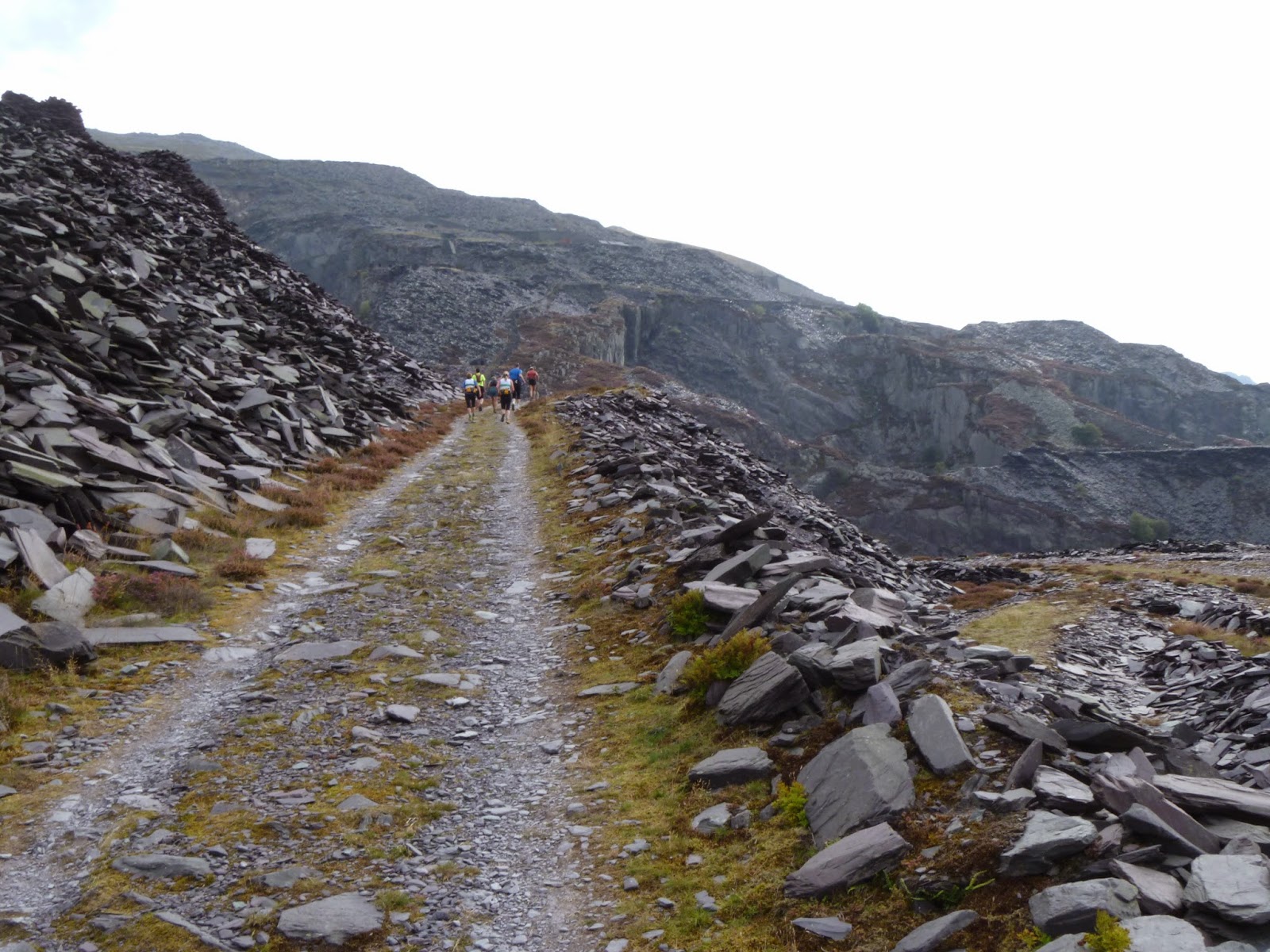
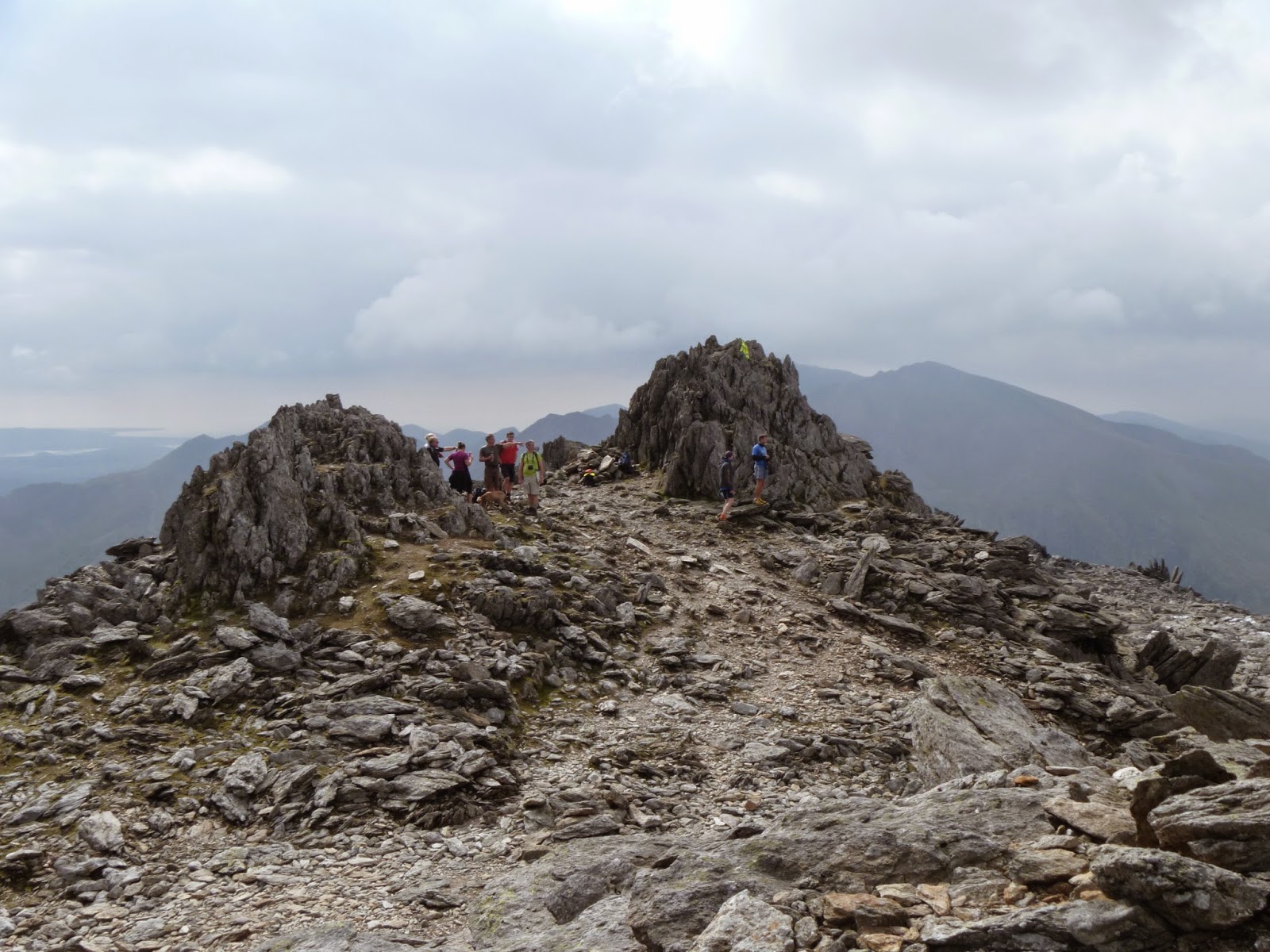
We would run to the path I had taken two years ago to get from town back to the mountaineering hut we were staying in, during a PCG weekend. At some point we would turn into Dinorwic Quarry, and climb all the way to the top.  800 metres of ascent in one go! From there it was easier for a while; from there we ran along the ridge for some 4 km (the same route we'd taken on that PCG trip). Then it'd go up to the next top; another 200m. Then down 250m and up 300m. And then 650 m down. Oh dear.

From the very start I felt slow. I don't know why! Even slower than I'd expected. So by the time the ascent started I was already somewhere in the back. And I fell behind more and more. Before I reached the first top I was the last Half Peris racer. But 30 minutes after our start, the full Peris Horseshoe started; that's, as the name implies, a race that's twice as long. And these runners were by now whizzing past! And when I reached the few kms of horizontal I ran a bit, but not much; quite often, the ground was way too uneven.
Walking up an incline of the slate quarry

Running up a quarry track - the runners are starting to disappear!

 The other runners (colourful dots)vanishing up the slope of the first peak

I knew I was slow, but what a landscape! What weather! I was having a great time. I struggled up the second peak, and was already almost the last of all the runners - including the full Peris ones. And in the pass below I brought the map out - some runners had headed off to the right of a lake ahead, but as far as I recalled, we had to go around the left. I was right!

 If the terrain is like this I'm not running!

 The last peak seen from the slope of the middle one. You can see the path running to the left of the little lake, and then curving to the top.

At the top of this last peak I realised how tired I was. And I was developing a headache. I carried some 2 litres of water, but I drank that much during the recent cricket match, and now I was doing much more demanding things! At the top I opened my bag of jelly babies. My blood sugar was running low! And I chatted a bit with the second last runner. He wasn't in a hurry either, and was willing to take a picture of me. But then we set off, to the finish we could see in the distance. It was way, way too steep for me to run. I pretty much walked all the way down. There was noone in sight. There was no sound. It was very peaceful!

The last peak!

Me still smiling, but not moving very fast. Behind my shoulder you can just see the cluster of buildings where the finish is

 You're in Wales or you're not; the course was festooned with a dead sheep

When I got close to the finish I heard calling. It was the race organisation; they had spotted me, and saw I was [proceeding too low on the hill. That way I would hit too steep terrain. So a chap guided me in; very nice! I felt a bit guilty, as I figured they probably had to keep the finish open extra long only for me. The second last chap must have come through ages ago! But they didn't complain. They wrote my time on a piece of paper (as I said, this was a low-tech race) and that was it. They pointed me to the bus. And in it were several more runners! I wasn't as much slower as the rest as I had thought.

The bus took us back to Llanberis. I walked back to the hotel where registration had been, and where my car was parked. There would be soup for all the runners! I could do with some. I got me a cup and went to the terrace. Where I was spotted by the chap with whom I'd chatted at the start! And his friend. I joined them, and we had a good time. And when there was rumour of a prize ceremony the fast runner, by the name of Jacob, wanted to go and see; he figured he's been the youngest runner and therefore also the fastest in his one-man age category. Unfortunately, they only give prizes to the fastest all-round, and the fastest in the 40+, 50+, and 60+ categories (there had been no 70+ runners).

When that was done I wanted to jump into Llyn Padarn. I was sticky and salty and a bit battered! And cold water helps against that. And cold it was! And it did help. After that bath I was ready to drive home. But there I was still zonked. I went as far as taking an actual hot bath! That's rare. But it felt good.

So what's the verdict? It was great, but I think I only ran some 10% of the race. The rest I had to walk! Too steep up, too steep down, or too rocky. I slightly shocked the guy who guided me in; I said I'm rubbish on rough terrain. He didn't know what to say. Why enter one of the most mountainous races in the entire country if you are rubbish on rough terrain? But I explained I wanted to be sure.
 And I think I am now. It took me some 3:45h, which boils down to a pace of ~3.5 km/h. I think I should give up on this, and next time just walk, alone (or with other hikers) and with mountain boots rather than running shoes. I won't go any slower, I get the same views, but I keep nobody waiting, and I can bring more coffee. And for running, I think I'll stick to road and trail races!

16 September 2014

Back to slate

I'd spent two consecutive Thursday nights in Benallt mine. The others had spent more than that, as they had started exploring while I was at sea. And the owner of the maypole would be back the week after, so it was decided to take a break from this mine, and return to slate for a week. And I'm sad to miss what may well be the final Benallt action, as I'll have to give next week a miss, but I don't mind a bit of slate myself! But slate mines are often big. And if you want to get from one end to the other in a reasonable time you need to keep moving. So no pictures on this trip! But it was nice. And it was probably our last trip in quite a while with Ross. I could imagine he doesn't see that as an undiluted loss; I think our habits of scampering under and over all sorts of less than stable constructions and formations had him frequently wondering what on Earth he had got himself into, but we'll miss him. And there were wild plans of jumping in the stream afterwards, and raising a glass to Ross, but it had got too late for any of that. One can't have it all! But one can have slate.

 Generic pic of a part of the mine we passed, taken on a different trip by Linden