I don’t tend to go anywhere without my camera. I’m a blogger, after all. So I even crawled through the tightest places of Pridhamsleigh cave, doing rescue training, with my camera in my chest pocket. The blog bears witness to this. But the chest pocket is not a really good place for the camera, and beside that, both camera and ribs suffer some wear and tear from such circumstances. So for the next training I decided to be a serious rescuer, and leave the camera in my bag. And of course this time there was no squeezing involved, and I could have easily taken it. Ah well!
It became clear that this time the training focused not on retrieving victims from squeezy and uncomfortable places, but more on scouting skills. The alleged victims were reported to have gone missing in a mine with many, many entrances, many of which being dead ends. This was more about effectively spreading out, systematic searching, and lots of feedback over the radio. We spent most of the time in the woods! But it was both educational and fun. Monday there will be the annual general meeting of the rescue people, and I presume there it will be decided if I join them for real! And if I do, I'll try to find a good balance between developing my rescue skills and maintaining my journalistic merits.
16 May 2010

12 May 2010
Margot's science outreach: temperature!
It’s been a while! Time for more science outreach. I explained my first monsoon paper, which has most of the background information, here, and the second one, in which I actually do reconstruct monsoon, here. Time now to move further back in time! Time to elaborate on my article “Saher, M.H., Rostek, F., Jung, S.J.A., Kroon, Bard, E., D., Schneider, R.R., Greaves, Ganssen, G.M., M. and Elderfield, H.: Sea Surface Temperature in the western Arabian Sea in the penultimate and last interglacial: a comparison of UK’37 and Mg/Ca paleothermometry. Paleoceanography, Vol. 24, PA2212, doi: 10.1029/2007PA001557, 2009”.
Both papers I discussed before go no further than 20.000 years, and there’s more to life. In the first outreach blog post I already describe the use of the fossil record; if you only know what things are like in the last 20.000 years your knowledge is too narrow. Climate depends on boundary conditions, and there’s more possible variation in these than there is in the last glacial-interglacial cycle. And now the time has come to go have a look at the previous one! But before I get to disclosing my monsoon reconstruction, and its implications, I have to elaborate on some background again. And not only for that reason; the article with the monsoon reconstruction in it is not yet published... it’s not even submitted. I regret that; I’m impatient! But I have a very overworked co-author, and it just takes long.
So what did I do before I got underway with the monsoon? I ended up on the side track of proxy evaluation. Proxies being the things we measure to indirectly find out what we want to know. We measure all kinds of things on the sediments and the microfossils we sieve out of them, but someone somewhere must have found out how these sediments relate to the environmental parameters we want to reconstruct. And generally, it turns out to be quite complicated. So there’s still lots of work being done on fine-tuning the proxies we have, and finding new ones. And I added to that body of work, by taking two ways of reconstructing sea water temperature, performing them on the same sediments, and seeing if they would give the same answers. And if not, try to find out why.

Something like “temperature” seems so straightforward. But is it? If someone writes “the temperature 128.000 years ago was 25°C”; what do they mean? Global annual average? At one meter above sea level, as modern temperatures are given, or somewhere else? And if they are more specific, and say things you are more likely to read in literature, such as “sea surface temperature in the South China Sea 135.000 years ago was 17°C”, it still is a bit ambiguous. I wonder if a surface technically can have a temperature. And would it be, again, an annual average?
Generally speaking, if someone writes about sea water temperatures they would mean the annual average temperature of the upper part (typically 50m) of the water column. If it is something else it would be specified. But if we read the information as documented in, for instance, the shell of a foraminifer, would that information indeed give just that? Not very likely.

All reconstructions have their own peculiarities. And they tend to not give you something as regular as the annual average over a spatial interval of nicely round figures. And that can be a problem, but it can also be an advantage. I already explained in the monsoon blogpost that we for instance use the different seasonal cycles of the various foraminifera species for monsoon reconstruction. If one lives only in summer and another one all the time you can reconstruct the difference between summer and annual average from measuring the species separately. A similar thing can be done with ocean stratification. Measure one species that lives in the upper 50m and one that lives 100m deep. If they contain the same signal, the whole water column down to 100m must have been mixed. And it may not be evident to everybody why water stratification matters, but I’ll get to that in some later blog post.
So what was it I did for that third article? I compared two methods. One is the already described method of Mg/Ca on planktonic foraminifera. The other one is new to this blog: it is alkenone unsaturation. Alkenones are organic molecules that a specific type of plankton, viz. coccolithophorids, seem to use to keep the contents of their cells at the right viscosity, or something like that. Coccolithophores, by the way, are algae with a calcite skeleton, and they are small but abundant; they produce about half the oxygen in our atmosphere (so maybe you should say “thank you, coccolithophorids!” next time you breathe in), they are what school board chalk is made of, and what the white cliffs of Dover are made of too. And their alkenones have 37 C atoms, and some of the bonds between them are double and some are not, and just how many of them are double depends on temperature. And the good thing is, that these alkenones are amazingly robust, and you can just leave them lying around on the sea floor for millions of years, and then still measure their (unaltered) number of double bonds.

So what did we expect to see, using both these methods? To be honest, we should not have had any noteworthy difference. The coccolithophorids (or cocco’s for short) responsible for the alkenones have, at least in modern days, a quite similar distribution in both time and space to our foraminifera. So they should be recording the same thing! And if they don’t, it might be due to the plankton behaving differently then compared to what they do now, and we might be able to find out how. That would then be excellent information for the interpretation of all records of these kinds.
So what did we see? Remember we were reconstructing the previous interglacial, and quite some time around it. So we expected to see the low temperatures of the end of that ice age, then the warming up to the interglacial, and then the stepwise descent into the next ice age. And both temperature records thus constructed indeed showed that. But not in the same way! The alkenones showed much higher temperatures over the whole period, and the glacial-interglacial differences were much smaller.
Our Mg/Ca temperature record showed us temperatures in the range that we expected. Glacial temperatures like these in the last glacial, and then the rise into the interglacial, which at its peak was a bit warmer than the Holocene, and then intermediate temperatures. So if the little critters had not been changing their preferences concerning when and where they live in the last 150.000 years, the last interglacial was what we largely already knew from literature.

Then the alkenones. High temperatures all the way! And to a certain extent that was expected; nobody knows why but they always give you higher temperatures than you can really explain. They magically seem to give annual average temperatures, even though they do not live in representative parts of the year! In our own core this offset is also seen in the last 20.000 years. But the difference in the previous interglacial is much bigger; 3.5°C on average. That’s much!
We first tried to explain this by assuming the alkenones were right, and the forams had just had a different preference in these times, but we didn’t manage; you would see a change in environment also in their isotopic composition, and there was nothing there.
Then we had to try the other way around. The forams were right and the cocco’s had changed! But that went wrong too. They could not reasonably have moved up in the water column, for they already live so shallow. It would be difficult to imagine them living in the warm intermonsoon season, as the whole reason it’s so warm is there is no water mixing, and that means no food.
We also considered disruptive mechanisms. Maybe the forams had been dissolving! Maybe the alkenones, which tend to be found in much finer sediments than the bulky forams, were just flushed in form elsewhere by some passing current. Maybe squirmy wormy things had been overturning the sediment, and misplaced interglacial alkenones in layers of glacial sediments! But there always was some argument against.

So in the end we had to give up. And since we can explain the foram-based record, but not the cocco-based record, we tend to believe the forams. The fact that cocco’s already had a shady image only strengthens our suspicions. But what would have been great would have been if we would have detected some change in environmental preference of one of our small creatures in the difference in temperature signal, and we haven’t. Too bad! Sometimes it just works out that way. At least now I have a better idea of how to evaluate temperature records of these kinds...
This article, by the way, was a difficult one to write. For most of the blog-readers the other names on the author list probably are just names, but of course there’s people behind them. Harry Elderfield happens to be a British Mg/Ca god, while Edouard Bard is a French alkenones god. One of them is a soft spoken, amiable man, while the other one is a genius who cannot stoop to the level of mortals, and often seems to die of impatience and indignation when confronted with the inferior utterings of those. And I was just a shy little PhD student. The article clearly sings the praise of forams, so I had to be very very careful in my wordings to get this article past the cocco man. And that would surely be the soft spoken, amiably man? Unfortunately not...
Edouard gave me a hard time on this one. If I had sent around a draft version, and I would see I had a response from him, I would always first breathe out slowly, gather all my courage, and then open the mail. And then let the shouting poor over me. But he was never unjust, and by whipping me so hard he managed to get everything out that I had in me. And it paid off; the article did get attention. It was top download of the journal for a while. And even though it did not deliver what we had hoped, I am actually above average proud of this one!
Both papers I discussed before go no further than 20.000 years, and there’s more to life. In the first outreach blog post I already describe the use of the fossil record; if you only know what things are like in the last 20.000 years your knowledge is too narrow. Climate depends on boundary conditions, and there’s more possible variation in these than there is in the last glacial-interglacial cycle. And now the time has come to go have a look at the previous one! But before I get to disclosing my monsoon reconstruction, and its implications, I have to elaborate on some background again. And not only for that reason; the article with the monsoon reconstruction in it is not yet published... it’s not even submitted. I regret that; I’m impatient! But I have a very overworked co-author, and it just takes long.
So what did I do before I got underway with the monsoon? I ended up on the side track of proxy evaluation. Proxies being the things we measure to indirectly find out what we want to know. We measure all kinds of things on the sediments and the microfossils we sieve out of them, but someone somewhere must have found out how these sediments relate to the environmental parameters we want to reconstruct. And generally, it turns out to be quite complicated. So there’s still lots of work being done on fine-tuning the proxies we have, and finding new ones. And I added to that body of work, by taking two ways of reconstructing sea water temperature, performing them on the same sediments, and seeing if they would give the same answers. And if not, try to find out why.

A random picture of a random machine used in proxy studies, in this case a spectrographer of Cambridge university
Something like “temperature” seems so straightforward. But is it? If someone writes “the temperature 128.000 years ago was 25°C”; what do they mean? Global annual average? At one meter above sea level, as modern temperatures are given, or somewhere else? And if they are more specific, and say things you are more likely to read in literature, such as “sea surface temperature in the South China Sea 135.000 years ago was 17°C”, it still is a bit ambiguous. I wonder if a surface technically can have a temperature. And would it be, again, an annual average?
Generally speaking, if someone writes about sea water temperatures they would mean the annual average temperature of the upper part (typically 50m) of the water column. If it is something else it would be specified. But if we read the information as documented in, for instance, the shell of a foraminifer, would that information indeed give just that? Not very likely.

A lady about to measure temperature over a depth interval directly
All reconstructions have their own peculiarities. And they tend to not give you something as regular as the annual average over a spatial interval of nicely round figures. And that can be a problem, but it can also be an advantage. I already explained in the monsoon blogpost that we for instance use the different seasonal cycles of the various foraminifera species for monsoon reconstruction. If one lives only in summer and another one all the time you can reconstruct the difference between summer and annual average from measuring the species separately. A similar thing can be done with ocean stratification. Measure one species that lives in the upper 50m and one that lives 100m deep. If they contain the same signal, the whole water column down to 100m must have been mixed. And it may not be evident to everybody why water stratification matters, but I’ll get to that in some later blog post.
So what was it I did for that third article? I compared two methods. One is the already described method of Mg/Ca on planktonic foraminifera. The other one is new to this blog: it is alkenone unsaturation. Alkenones are organic molecules that a specific type of plankton, viz. coccolithophorids, seem to use to keep the contents of their cells at the right viscosity, or something like that. Coccolithophores, by the way, are algae with a calcite skeleton, and they are small but abundant; they produce about half the oxygen in our atmosphere (so maybe you should say “thank you, coccolithophorids!” next time you breathe in), they are what school board chalk is made of, and what the white cliffs of Dover are made of too. And their alkenones have 37 C atoms, and some of the bonds between them are double and some are not, and just how many of them are double depends on temperature. And the good thing is, that these alkenones are amazingly robust, and you can just leave them lying around on the sea floor for millions of years, and then still measure their (unaltered) number of double bonds.

These cliffs, on the Isle of Wight, are the same stuff as these near Dover.
So what did we expect to see, using both these methods? To be honest, we should not have had any noteworthy difference. The coccolithophorids (or cocco’s for short) responsible for the alkenones have, at least in modern days, a quite similar distribution in both time and space to our foraminifera. So they should be recording the same thing! And if they don’t, it might be due to the plankton behaving differently then compared to what they do now, and we might be able to find out how. That would then be excellent information for the interpretation of all records of these kinds.
So what did we see? Remember we were reconstructing the previous interglacial, and quite some time around it. So we expected to see the low temperatures of the end of that ice age, then the warming up to the interglacial, and then the stepwise descent into the next ice age. And both temperature records thus constructed indeed showed that. But not in the same way! The alkenones showed much higher temperatures over the whole period, and the glacial-interglacial differences were much smaller.
Our Mg/Ca temperature record showed us temperatures in the range that we expected. Glacial temperatures like these in the last glacial, and then the rise into the interglacial, which at its peak was a bit warmer than the Holocene, and then intermediate temperatures. So if the little critters had not been changing their preferences concerning when and where they live in the last 150.000 years, the last interglacial was what we largely already knew from literature.

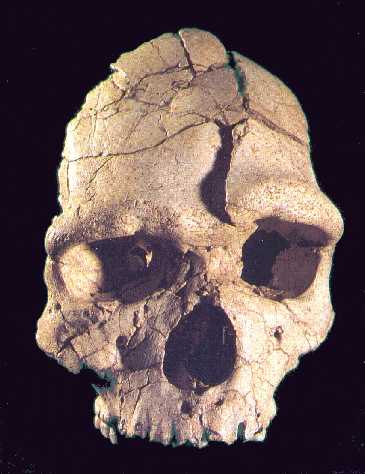
This is what human skulls looked like at the time. Picture taken from: www.talkorigins.org/faqs/homs/arago.jpg
Then the alkenones. High temperatures all the way! And to a certain extent that was expected; nobody knows why but they always give you higher temperatures than you can really explain. They magically seem to give annual average temperatures, even though they do not live in representative parts of the year! In our own core this offset is also seen in the last 20.000 years. But the difference in the previous interglacial is much bigger; 3.5°C on average. That’s much!
We first tried to explain this by assuming the alkenones were right, and the forams had just had a different preference in these times, but we didn’t manage; you would see a change in environment also in their isotopic composition, and there was nothing there.
Then we had to try the other way around. The forams were right and the cocco’s had changed! But that went wrong too. They could not reasonably have moved up in the water column, for they already live so shallow. It would be difficult to imagine them living in the warm intermonsoon season, as the whole reason it’s so warm is there is no water mixing, and that means no food.
We also considered disruptive mechanisms. Maybe the forams had been dissolving! Maybe the alkenones, which tend to be found in much finer sediments than the bulky forams, were just flushed in form elsewhere by some passing current. Maybe squirmy wormy things had been overturning the sediment, and misplaced interglacial alkenones in layers of glacial sediments! But there always was some argument against.

Arty picture of a brittle star; one of these creatures that is likely to disturb our beloved sediments
So in the end we had to give up. And since we can explain the foram-based record, but not the cocco-based record, we tend to believe the forams. The fact that cocco’s already had a shady image only strengthens our suspicions. But what would have been great would have been if we would have detected some change in environmental preference of one of our small creatures in the difference in temperature signal, and we haven’t. Too bad! Sometimes it just works out that way. At least now I have a better idea of how to evaluate temperature records of these kinds...
This article, by the way, was a difficult one to write. For most of the blog-readers the other names on the author list probably are just names, but of course there’s people behind them. Harry Elderfield happens to be a British Mg/Ca god, while Edouard Bard is a French alkenones god. One of them is a soft spoken, amiable man, while the other one is a genius who cannot stoop to the level of mortals, and often seems to die of impatience and indignation when confronted with the inferior utterings of those. And I was just a shy little PhD student. The article clearly sings the praise of forams, so I had to be very very careful in my wordings to get this article past the cocco man. And that would surely be the soft spoken, amiably man? Unfortunately not...
Edouard gave me a hard time on this one. If I had sent around a draft version, and I would see I had a response from him, I would always first breathe out slowly, gather all my courage, and then open the mail. And then let the shouting poor over me. But he was never unjust, and by whipping me so hard he managed to get everything out that I had in me. And it paid off; the article did get attention. It was top download of the journal for a while. And even though it did not deliver what we had hoped, I am actually above average proud of this one!
10 May 2010
Phone the newspaper: Margot goes for a run!
There’s many strange things about the English. One thing that struck me is that in daily life they tend to be fairly passive, but as soon as it concerns charity they fall over themselves running, biking and getting active in all sorts of way, all for a good cause. And there’s something charming about that.
In summer there will be a run for something, breast cancer research or something, and I wondered if I should join. It would be an excellent chance for getting a real English experience! But I was not sure. I never run! I haven’t run since I was 17. I don’t like running. But that may be exactly the point; you run for money, of course, and as everybody who knows me knows I don’t like that sort of stuff, they might actually sympathise more, and be willing to pay. If I would bike for charity nobody would take that seriously.
Anyway. I was still pondering. I had decided I should first have a trial run. Who knows what sort of trouble I get myself into if I make my old body run! But I can’t motivate myself. And then, suddenly, I was just socializing away with one of my colleagues (Little Jon, who has figured in this blog before, for instance here), when he spoke of running. Running? Jon Running? I was more used to tales of him moving from A to B with the help of some engine of sorts. And having a big pint afterwards. And then I had an idea! I asked if he would mind if I would join him. If I have a goal in the shape of someone to keep up with, I have a chance of lasting. And he didn’t mind.

Remember these shoes? Me neither!
And then it turned out it had just been my failing observation skills that had lead to me not knowing Jon was some sports hero. He seems to be much faster than Rob, our ridiculously young, tall, disciplined, fanatic PhD student! Damn what was I getting myself into. Nervously I dug out clothes that would be OK for running from underneath a thick layer of dust.
It was a wonderful day for it. So there wen went. And lo and behold, I stood my ground! I could keep up! And sometimes I had no breath left for talking, but at such moments, Jon generally didn't either. That would be the uphill bits, and then on the flat or downhill bits I got my breath back. I admire people who can do this on their own, but I'm also proud of myself that I pulled this off. Maybe I'll even do it again!

My face afterwards...
Anyway. I have checked that run against cancer. Subscription is already closed!
Back to the Moors
I was supposed to go caving this Sunday, but the trip got cancelled. And in the past many weeks I’ve always been working, caving, travelling or being ill. So I hadn’t been to the Moors for a while. And my poor car was entirely neglected on the street; my throat had kept me from taking it anywhere. And I’m still such a new driver I should try to avoid not driving for weeks on end. So the decision was easily made: a small trip to the Moors! And any other landscape I would run into. It was a pleasant walk, and it resulted in some nice pics. Finally!

 The Moors! Long time no see.


 Signs of spring everywhere!
 I walked back along a river that had made some nice granite sculptures.
 I had lunch at the river too.
 My view while having lunch! Could be worse.
 I want to go climbing here somewhere soon!


09 May 2010
Religious knowing?
Religion and science. Both address the big questions of life. And they do that from two mutually exclusive viewpoints. At least, that’s what most people agree on. But not all.
Many years ago I saw a book for sale: The psychology of religious knowing. It didn’t look peer-reviewed, but it evidently was meant as a serious scientific book. I was fascinated! Religious knowing? I was not sure if the authors had been studying people that claim to have religious knowledge, or that they claimed to have that knowledge themselves, and studied it. In the first case it may have been interesting science. A lot happens in the name of science, and it is very relevant to have psychological insight in those who act thus. And you may never find out if those who claim to read God’s mind really believe themselves that they do, or that they enjoy using religion as a justification to serve their own goals, but that is just one of these complicating factors of social science. (It would not surprise me that if you toss someone’s head in a CAT-scanner you may be able to see the difference through observing which part of the brain fires when, but I have problems imagining the big players in world religion volunteering to undergo such an experiment...) Social science is not, and never will be, natural science, but that does not mean it is not valuable, and social scientists have, as far as I know, come up with an impressive array of tricks to deal with that complication.

So what can I conclude from this book? It was an interesting excursion into the religious mind. And now I have seen how those with the best chances of getting away with it, try to somehow hammer square science into the round religious hole (or vice versa). I am not at all convinced! At all. Nevertheless, I still think they have valuable things to say. So I expected to decide to throw away this book after having read it, but all in all it is actually something I could recommend!
Many years ago I saw a book for sale: The psychology of religious knowing. It didn’t look peer-reviewed, but it evidently was meant as a serious scientific book. I was fascinated! Religious knowing? I was not sure if the authors had been studying people that claim to have religious knowledge, or that they claimed to have that knowledge themselves, and studied it. In the first case it may have been interesting science. A lot happens in the name of science, and it is very relevant to have psychological insight in those who act thus. And you may never find out if those who claim to read God’s mind really believe themselves that they do, or that they enjoy using religion as a justification to serve their own goals, but that is just one of these complicating factors of social science. (It would not surprise me that if you toss someone’s head in a CAT-scanner you may be able to see the difference through observing which part of the brain fires when, but I have problems imagining the big players in world religion volunteering to undergo such an experiment...) Social science is not, and never will be, natural science, but that does not mean it is not valuable, and social scientists have, as far as I know, come up with an impressive array of tricks to deal with that complication.

In the second case I was curious to see how they would try to somehow blend religion and science (ne’er the twain should meet!) to some homogeneous mixture. And when I was at home with my tonsillitis I finally got down to reading it, and finding out. It turned out to be the second option.
The two authors evidently claimed religious knowledge in both themselves and their study objects. And I always find such things a bit dodgy; if you’re religious you believe in a higher power. And who are you to claim you understand that power? Christians have the Bible, for instance, but isn’t it major hybris to claim to know how that book should be interpreted? And if you decide to follow that line of thought the only thing left of religion is a general striving to live life in a “good” way, but you need not be religious to do that.
Evidently, the authors do NOT follow that line of thought. So what do they see as religious knowing? They had interesting analogues for it. One of them was the “tip of the tongue” effect; if you can almost remember something, a name for example, and suddenly it comes to you, you knów it’s the right answer. It feels different from al l the almost-right names swirling around in your head before you grasp the right one. And they say religious knowledge feels like that. A bit dodgy, though; I imagine the “tip of the tongue” effect to be a sort of pattern matching. You have the name you look for somewhere in your system, and you can compare everything you can come up with with that name, and when you have a fit you know you got it. But with a lack of previous factual information in your brain, the analogy with religious knowledge goes wrong, unless you assume there is some mystical information present that you do the pattern matching with. But that’s not science.
The better analogy they had was personal insight gained, for example, in psychotherapy. During such sessions (or just on the phone with your sister, just to name a random example) you can reach a sort of aha-Erlebnis. Suddenly it dawns on you, for instance, that that nasty person treating you so badly actually is you allowing that person to do that, just to name a bit of a cliché. And they say that such eye-openers also occur religiously. Suddenly one may understand something about God. And they continue with observing that such events often happen in times of stress, and that they are followed by a change in attitude and/or behaviour. If they aren’t the person claiming the insight is a charlatan (their words!).
The fact that they claim that this knowledge is an aspect of some religious truth, and not a special type of personal insight, makes me discard this as non-science. If only because different people can come to mutually exclusive insights that still would qualify as “knowledge” in this definition. And religion is faith and cannot, by definition, be proven, and I think everyone who tries anyway gets something wrong somewhere. And may well in the process damage the name their religion has. Not by any means seriously; leave that to those murdering and oppressing in the name of some god, but damage nonetheless. Yet reading this book I got sympathy for their efforts anyway. I discard the notion of religious knowledge, but if you agree to disagree and read what else they have to say, it’s interesting anyway. What is interesting about it?
Some things were just funny trivia, such as results on how neuroticism relates with church attendance and racial prejudice. It seems that those who occasionally go to church are significantly more neurotic and racist than those who either go very often, or never at all...
Another thing I liked was their discussion of prayer. They describe a simplified evolution in how one prays through life. It starts with children, hardly grasping the concept of god their parents have been trying to impose on them, praying for material goods and personal gain. God as Santa, and if you don’t get what you want, you must have been naughty. Later the kid might conclude from an unanswered prayer that it wished for the wrong thing. In adolescence, a stronger aspect of confession seems to come in; not surprising if you see what mess adolescents can manoeuvre themselves into sometimes. And then the final stage: adult prayer, where praying serves more as a means of making sense of the world, reflecting on the self, and such things. If I may rephrase it; no more God as a mail-order service, or an older sibling that can put things right, but God as an excuse to take some time to reflect on right and wrong, purpose, life’s difficulties, and whatnot.
Some time used one proper reflection is one of these things the western world seems to really need more of. Indications of people living shallow, consumptive lives are ubiquitous, and if more people would reach the stage of this adult prayer, or, to take it out of its religious context, thorough reflection, this would truly be a better place. At least, that’s what I genuinely believe (!).
07 May 2010
Boobquake
I'm weeks late with blogging about this! But better late then never.
On Monday the 26th of April I was walking over the campus when Isuddenly felt my head clog up with slime and my tonsils swelling to uncomfortable dimensions. I figured it would be best to go home, so I went to my office, left a message on internet regarding my state, checked my mail, and left. One mail puzzled me a bit: it concerned "boobquake", whatever that may be. It sounded dodgy, but the sender was trustworthy, so I checked it out. And this is what I found.

And then even the Iranians caught up. She made it to the national news! An honour. But I must admit that when I saw that it scared me too. Religious fanatics tend to have their own ideas of what to do with provocatively dressed women. And the world is as big as the screen of your TV and computer! I really disliked myself for being scared. If we all are scared nobody will stand up against dangerous nutters! I do hope that if I ever find myself in the situation in which I can blog for a good cause, and it takes off, I will stand like Blag Hag does, whether shitting my pants or not...
On Monday the 26th of April I was walking over the campus when Isuddenly felt my head clog up with slime and my tonsils swelling to uncomfortable dimensions. I figured it would be best to go home, so I went to my office, left a message on internet regarding my state, checked my mail, and left. One mail puzzled me a bit: it concerned "boobquake", whatever that may be. It sounded dodgy, but the sender was trustworthy, so I checked it out. And this is what I found.

This page can be found here
A girl indignant about Irani religious fanaticism, who had the idea to tackle this with a sense of humour. For those too impatient to read the above screenshot: she figured that if the hypothesis is stated that immodestly dressed women do create earthquakes,we should test that hypothsis, and en masse wear smething very revealing. That should lead to a serious quake. Or falsify the hypothesis. Great idea!
Unfortunately, the great dress-down was that very day, and I was falling ill, so I was more inclined to cover up. Even if I would have shamelessly flaunted any feminine asset I could find, there would have been nobody to see it as I was straight off to bed. Missed chance!
With or without me, this thing had gained momentum, and caught international attention. Those who have checked out the blog of the inciter will have seen she did not expect anything big to happen, but before she knew it she had to defend herself against enthusiasts clogging her mailbox, small-breasted women complaining they felt left out, feminists claiming she was being immoral and/or offensive and whatnot. The power of a blog! I can only watch in awe.
And then even the Iranians caught up. She made it to the national news! An honour. But I must admit that when I saw that it scared me too. Religious fanatics tend to have their own ideas of what to do with provocatively dressed women. And the world is as big as the screen of your TV and computer! I really disliked myself for being scared. If we all are scared nobody will stand up against dangerous nutters! I do hope that if I ever find myself in the situation in which I can blog for a good cause, and it takes off, I will stand like Blag Hag does, whether shitting my pants or not...
06 May 2010
Power in a shifting world
The world is small and time goes slow. At least, when you’re very young. Your world is not much bigger than home and kindergarten, and a week is an eternity.
Then you grow up. The world expands. And at some point you become aware of the country. It was a confusing one; I could ask my dad if we were living in Holland and he would say yes. If I asked if we were living in Gelderland he said yes. If I asked if we were living in the Netherlands he said yes. What was that supposed to mean? Anyway, whatever country it was, by the time the fog lifted a bit it seemed to be ruled by one Ruud Lubbers*.
Then you grow up some more, and, even if you never venture there, you become aware of Foreign Countries. And Foreign Countries fall into three categories: nearby ones, very large ones, and not very interesting ones. So there was Belgium, ruled by Martens; Germany, ruled by Kohl; England (we’re talking the world through children’s eyes here, so don’t come correcting this to “the UK”), ruled by Thatcher; and France, ruled by Mitterrand. The nearby ones, evidently. And then there were America (sic) and China; ruled by Reagan and Deng Xiaoping, respectively. And the rest was too complicated to keep track of. And that was how the world worked.

And then came ’89. The fall of the Berlin Wall? No, the year it became clear that Very Large Countries are not ruled by the same people forever! Both Reagan and Deng Xiaoping stepped back. That was a bit of a paradigm shift. How are you supposed to keep track of who is head of state where, if they keep changing?
And then Thatcher lost it. Two years later, Martens yielded his post. So nearby countries did it too! But by then I was a proper teenager, and things were becoming clearer. When, two years after that, our very own prime minister lost the elections and was succeeded, I was already at university. It felt like a bit of the end of an era. Kohl kept the world as it was the longest; by the time he gave up his post to the next man, I think I was already living on my own in the Pijp, being all responsible and independent and such. As you are, as a student, evidently.
Anyway. Somewhere in the nineties, evidently, the idea that there is this thing called elections, and they may well lead to a shift in the faces you see on the 8 o’clock news, was properly illustrated. So let’s forget China, as there this idea has not properly settled yet; but in the remaining countries, this lead to interesting spectacles every so many years. Or every so many months, when Balkenende came to power, or what was supposed to pass for it.
So looking west, we saw John Major come. And then Tony Blair. And Gordon Brown. And now I suddenly live in the world in which that is orchestrated! It’s funny to have been watching a world for nearly 30 years and then suddenly find yourself right in it. It’s a bit like biking past the Amsterdam Arena, and hearing concerts going on by R. Kelly or the Backstreet Boys. These people are supposed to only live on TV! Not in real life. Just like UK elections. But there we are.
It’s special to vote in a foreign country for the first time! Norway didn’t have local elections while I was living there. So this is a debut. And it’s only local, as I already elaborated on in the “stem kwijt” blogpost, but it’s a vote! I've got the power! And I’m very excited to see what the results will be...


*: I do vaguely remember van Agt, but that did not damage the idée-fixe, for some reason.
Then you grow up. The world expands. And at some point you become aware of the country. It was a confusing one; I could ask my dad if we were living in Holland and he would say yes. If I asked if we were living in Gelderland he said yes. If I asked if we were living in the Netherlands he said yes. What was that supposed to mean? Anyway, whatever country it was, by the time the fog lifted a bit it seemed to be ruled by one Ruud Lubbers*.
Then you grow up some more, and, even if you never venture there, you become aware of Foreign Countries. And Foreign Countries fall into three categories: nearby ones, very large ones, and not very interesting ones. So there was Belgium, ruled by Martens; Germany, ruled by Kohl; England (we’re talking the world through children’s eyes here, so don’t come correcting this to “the UK”), ruled by Thatcher; and France, ruled by Mitterrand. The nearby ones, evidently. And then there were America (sic) and China; ruled by Reagan and Deng Xiaoping, respectively. And the rest was too complicated to keep track of. And that was how the world worked.

And then came ’89. The fall of the Berlin Wall? No, the year it became clear that Very Large Countries are not ruled by the same people forever! Both Reagan and Deng Xiaoping stepped back. That was a bit of a paradigm shift. How are you supposed to keep track of who is head of state where, if they keep changing?
And then Thatcher lost it. Two years later, Martens yielded his post. So nearby countries did it too! But by then I was a proper teenager, and things were becoming clearer. When, two years after that, our very own prime minister lost the elections and was succeeded, I was already at university. It felt like a bit of the end of an era. Kohl kept the world as it was the longest; by the time he gave up his post to the next man, I think I was already living on my own in the Pijp, being all responsible and independent and such. As you are, as a student, evidently.
Anyway. Somewhere in the nineties, evidently, the idea that there is this thing called elections, and they may well lead to a shift in the faces you see on the 8 o’clock news, was properly illustrated. So let’s forget China, as there this idea has not properly settled yet; but in the remaining countries, this lead to interesting spectacles every so many years. Or every so many months, when Balkenende came to power, or what was supposed to pass for it.
So looking west, we saw John Major come. And then Tony Blair. And Gordon Brown. And now I suddenly live in the world in which that is orchestrated! It’s funny to have been watching a world for nearly 30 years and then suddenly find yourself right in it. It’s a bit like biking past the Amsterdam Arena, and hearing concerts going on by R. Kelly or the Backstreet Boys. These people are supposed to only live on TV! Not in real life. Just like UK elections. But there we are.
It’s special to vote in a foreign country for the first time! Norway didn’t have local elections while I was living there. So this is a debut. And it’s only local, as I already elaborated on in the “stem kwijt” blogpost, but it’s a vote! I've got the power! And I’m very excited to see what the results will be...

Me proudly on my way to the polling station with my polling card

I got to go to church in the process!

One is greeted with a plethora of infomation...

Behold the crowds! The Brits are unimaginably eager to make a political change, in the most exciting elections in many, many years
*: I do vaguely remember van Agt, but that did not damage the idée-fixe, for some reason.
Subscribe to:
Posts (Atom)